Cat Lovers Community Team

For cats that required surgical correction, follow-up appointments are necessary, usually within 10-14 days after surgery. The abnormal rolling of the eyelid may introduce hair directly onto the cornea and conjunctiva, causing scratches, ulcers, inflammation, discharge and pain. I got my kitty spayed today and her eyes seem i little weird. Diagnosing entropion in cats is typically straightforward when eyelid hairs are rubbing the surface of the eye.
The information below is meant to provide general guidance only. The aim of the present study was to determine tear production in cats after general anaesthesia, and to identify possible causes of irritation. Entropion is especially irritating to the cornea, or the curved, clear part of the eye. When on these medications, try to minimize exposure to bright light (short leash walks, dimmed room lights).

Optixcare (eye lube plus) is a great general eye lubricating gel that helps soothe and keep the eye moist. Occasionally, cats with spastic entropion may need a temporary procedure called tacking that involves using sutures to keep the eyelid from rolling onto the eye during the healing process. Please do NOT use a microwave for heating up a warm pack since it can substantially heat the core of the cloth which can cause painful facial burns. In this instance, you may moisten a clean wash cloth with warm tapewater.
Some cats will have permanent corneal scarring and conjunctivitis even after correction of the entropion and may require life-long medications to maintain eye comfort and health. Like crusty and one if them she seems to be having a weird time opening. Lower eyelid entropion is most common, and usually occurs toward the outside edge of the eye. You may use a gel-filled cold pack, a ziplock bag filled with crushed ice or a bag of frozen peas.

The cloth should feel warm but not hot to the palm of your hand. Therefore, some temporary tearing and squinting may be seen when applying eye medications. Atropine, tropicamide) may make the eye more light sensitive (resulting in tearing and squinting) esp. Please make sure to provide a clean thin cushion (clean washcloth, a few layers of Kleenex, etc.
After an enucleation procedure, a cold pack may be placed on the surgical site 2-3 x daily for the first 3 days to help alleviate discomfort and for the soft tissue swelling to go down faster. However, eye gel use is recommended because the eye ointment consistently caused an irritation comparable to the foreign-body sensation reported in humans. In dogs, they may include oral Tylenol with codeine, tramadol, butorphanol; non-steroidals (NSAIDs) such as Rimadyl or meloxicam; or transdermal fentanyl (skin patch). Bring your cat or kitten to All About Cats Veterinary Hospital, for the best feline veterinarian care in Las Vegas, NV.
If this isn’t a normal thing with anesthetics i will call the vet first thing tomorrow. Entropion is an abnormal inward rolling of the upper or lower eyelids, causing abnormal, painful friction with the surface of the eye. Two hours after anaesthesia, blepharospasm of the right eye was observed in 92,7% (n = 3 of the cats. In these breeds, the eyes bulge more secondary to a shallow eye socket, causing crowding in the face and subsequent inversion of the eyelid.
Pain medications are usually prescribed for at-home use to alleviate pain. Instead of a cold pack, some patients rather seem to prefer a warm pack. Please be aware that all topical eye medications are associated with a slight burning or stinging sensation that should dissipate after a few seconds.
How long does it take for cats eyes to adjust?
Because of a lack of pigment, blue eyes appear blue because of the way light reflects out of them, but they are actually colorless. Cats have vertical, slit-shaped pupils that can swiftly adjust their size in response to different lighting conditions. In bright light, a cat’s pupils contract into thin slits to protect the sensitive retina from potential damage. Kittens start developing melanin at 4-6 weeks old, when the cells that make pigment migrate to the iris.
Both eyes are usually dilated by 2 weeks of age, and by 3 weeks of age, many kittens can focus with both eyes. During this time, their vision gradually improves, though the two eyes may not fully open at the same rate. Kittens grow at different rates depending on a variety of factors, but most newborns open their eyes between the ages of 2 and 16 days. Conversely, in low-light conditions, the pupils dilate (expand) widely to allow in as much light as possible, thereby optimizing visibility.
All newborn kittens have blue eyes, and the color of the eyes will change as the kitten grows, usually settling on the true color at about 8 weeks of age.
Are there any warning signs after cat surgery?
Many cats disappear to their favorite hiding spot when they are in pain, and others simply conceal their discomfort. For instance, after a cat’s spay operation, there could be seroma, or swelling, if the cat is too active too soon, causing fluid to get into the surgical site. A rare but serious complication is a complete dehiscence of a surgical wound, such as when an incision into the abdominal cavity comes undone. While some behavioral changes are to be expected, any prolonged signs of anxiety or discomfort may be cause for concern.
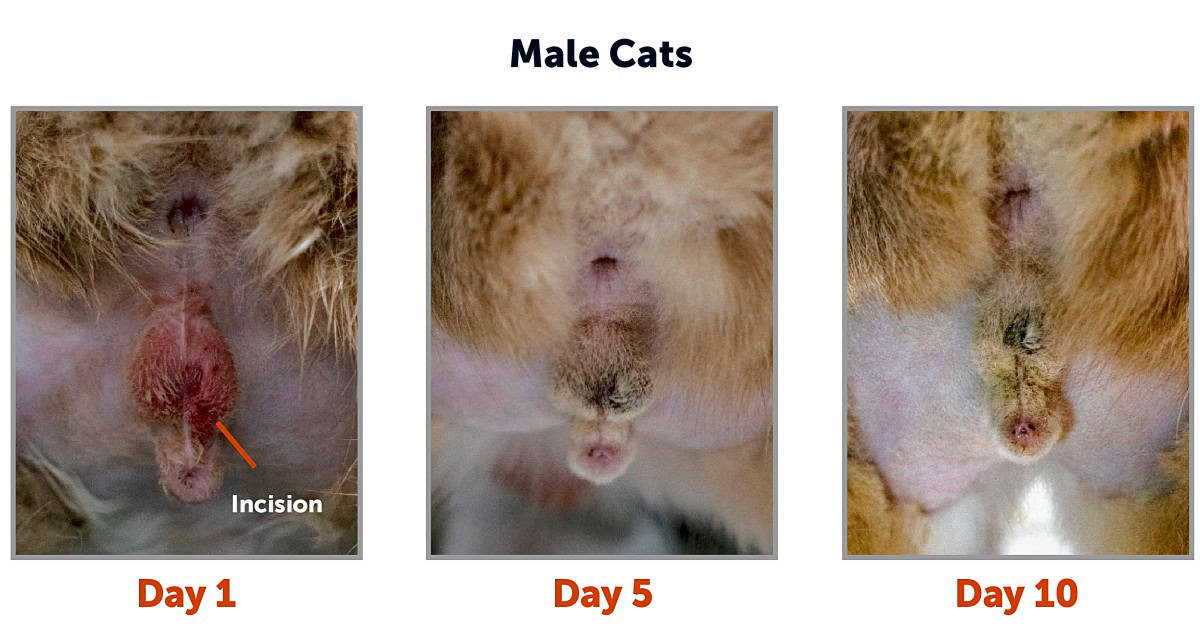
Contact your veterinary care team if your companion has not regained their appetite or started using their litter box again after a few days, and keep an eye out for signs of pain or infection. If the incision of your cat’s surgery isn’t bandaged, you can routinely check it for swelling, redness, pus, bad odor, or blood seepage. Due to general anesthesia, your cat may feel slightly nauseous and have a decreased appetite post-surgery.